The Bike Buying Guide
The definitive guide to buying a bike
Since 2011 we've helped thousands of riders find the right bike. This guide is everything we've learned, condensed: the six questions we ask every customer, how sizing actually works, and what 95% assembled really means. No jargon, no sales pitch, no 40-page detour.
What's in this guide
- First, do you really need a new bike?
- 1. How you'll use it
- 2. Terrain and conditions
- 3. Frame style
- 4. Size and fit
- 5. Accessories
- 6. Local shop support
- Bonus tip: ask questions
- Glossary: 50+ terms, translated
A word on the bike buying process
Bikes can be unnecessarily complicated machines, and everyone is chasing the perfect quality-to-value ratio, with price as the main driver for buying online. We won't discourage you from considering big box or online-only brands, but this guide sets a qualitative floor: brands that distribute through bike shops, including brands like Brooklyn Bicycle Co. that let you purchase online but only deliver professionally assembled bikes through local shops.
Why set that floor? Simple. If bike shops won't assemble the new bike you purchased, it's likely for good reason. They don't want to endanger their reputation or assume the liability should something go wrong with a bike of subpar quality.
Looks can be deceiving. A $299 bike will photograph as beautifully as a $999 bike. If you're only riding 2 or 3 times a year, you may be just fine on a bike like that. If you're looking for something durable and reliable, budget bikes are to be avoided. You wouldn't furnish your house top to bottom at a discount big box store; don't buy your daily commuter there either.
First: do you really need a new bike?
If you don't currently have a bike, skip ahead. Otherwise, allow us a moment.
We're huge proponents of working with your local bike shop to breathe new life into the bike hanging from the rafters of your parents' garage. That old bike is likely back in style again, and you'll save a good deal of money refreshing it. Work with your local shop to make sure they can source all the components needed to get it rolling again.
1. How do you plan to use your bike?
The most important question. Are you after a daily commuter, a grocery getter, or a high-performance road bike?
For a daily commuter, look for a versatile ride: a wider gearing range and the ability to accept a cargo rack and fenders. If you're riding recreationally around the neighborhood or to the supermarket, a simpler bike with fewer gears will serve you better. The goal is to avoid buying more bike than your use case needs.
Use cases to consider:
- Short, semi-frequent rides around your neighborhood or city
- Daily commuting to school or work
- Recreational rides around town or a local park trail
- Fitness rides to break a sweat
- Long road rides for building stamina
2. What are your riding conditions?
Think topography and terrain. Flat or hilly? Road or gravel?
Many riders focus on how many gears a bike has. Focus on the overall gearing range instead. More gears don't always mean better; they just mean more options between the highest and lowest gear. The range dictates how easily you can pedal up a hill and how fast you can get going down the other side.
Traveling shorter distances on relatively flat terrain? Consider a 3-speed internally geared bike. They're low maintenance and favored by bike shares for reliability. If your commute has real hills, look for a wider gearing range with more options.
A note on weather and brakes
A simple test: if you walked outside into a downpour, would you saddle up anyway? All-weather riders should add front and rear fenders to keep road grime off their clothes.
If you're consistently riding in all conditions, disc brakes are worth considering; they squeeze a caliper instead of the wet rim of your wheel and are known for better stopping power in heavy rain. But do your due diligence: on more economical bikes, the included disc brakes are often subpar quality. And frankly, disc brakes are one of the most oversold must-have features on a bike. Rim brakes stop perfectly well, even in light rain.
3. What frame style suits you best?
Diamond frames are favored for their clean lines and how easily they can be picked up. You'll see them in sport racing because they're more efficient at transferring energy from your body to the drivetrain. They're also simpler to load on a car rack.
Step-through frames are wardrobe friendly and easy to mount, particularly useful with a rear child seat or tall cargo. There's a reason step-throughs are among the most popular styles in Europe.
A brief note on riding posture
Posture is your torso's position relative to the ground. The more upright you ride, the more perpendicular your torso; a more aggressive posture tilts you forward. Beyond frame geometry, saddle height and handlebar height and angle are the big contributors. Some bikes offer minimal adjustment, others plenty.
4. Size matters: what's your height and inseam?
Our most important advice: when in doubt, reach out.
A well-fitted bicycle rides more efficiently, feels more comfortable, and handles more easily. All of it adds up to a bike you'll ride more often and for longer. Make sure you can confidently and comfortably hold the bike while stopped. You don't need to be flat-footed, but you should be able to stop and hold the bike without a rapid dismount.
Always:
- Measure your height and inseam accurately. Your pant size is not your inseam.
- Refer to the sizing chart for each model you're considering. Sizing is not uniform across the bike industry.
- Reach out for personalized guidance if you're between sizes.
Never:
- Assume sizing is the same across models or brands.
- Ride a bike you feel unsafe on or not in control of.
Bonus points if you can test ride at a local shop that carries the brand.
5. How do you plan to accessorize?
Accessories customize a bike to your needs, whether that's a child carrier or a rear rack for your laptop pannier. What matters at purchase time: confirm the bike can accommodate the accessories your use case requires, like fenders for rain or a rear rack for heavier loads. Every bicycle in our portfolio includes the braze-ons to attach any accessory a rider could need.
- Safety: bells, lights and reflectors, helmets, gloves
- Cargo: baskets, rear racks, front racks, pannier bags, saddle and frame bags, cargo bundles
- Security: locks, wheel locks, seat locks
- Convenience: water bottle and cage, fenders, mobile phone holder
6. Do you have a local bike shop?
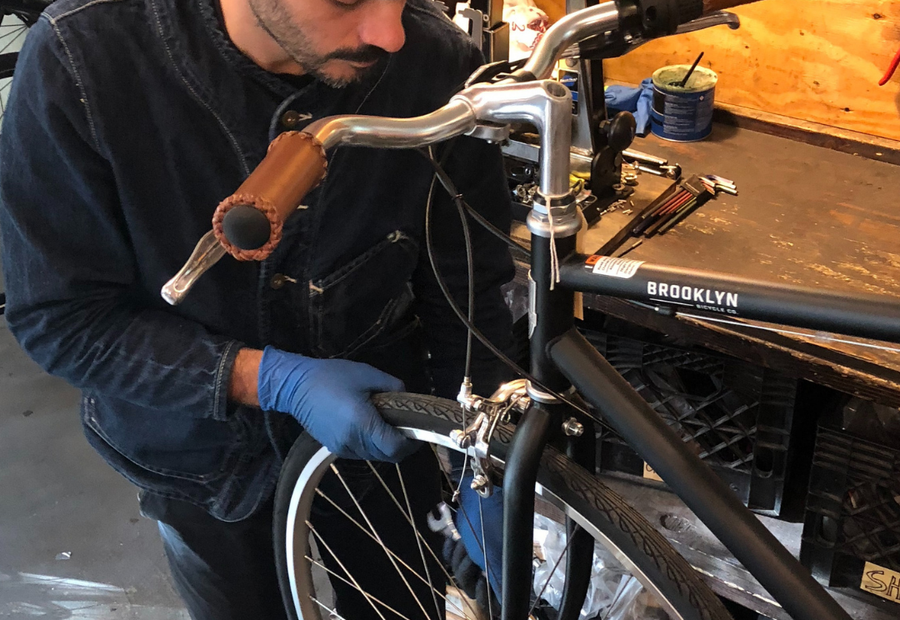
Why do you need professional assembly if your bike comes 95% assembled? Because 95% assembled really means about 70% assembled. You'll always need to install the front wheel, pedals, saddle, and handlebars, each with proper lubrication and adjustment. Then the wheels need truing, the brakes need adjusting, and the gearing needs tuning so the bike shifts smoothly.
Bikes aren't nightstands. The worst case of a poor furniture assembly is a wobbly bedside table. With a bike, it's serious safety concerns if your brakes aren't properly adjusted or your front tire isn't seated on the rim.
A professionally assembled bike rides better and lasts longer because parts don't wear prematurely from poor configuration. And for better or worse, the cheaper the bike, the more you'll benefit: one way brands cut costs is a subpar factory, which means stripped bolts and untrued wheels.
Here at Brooklyn, we won't ever ask you to assemble your bicycle. Through our Buy and Ride program, we ship our bikes to local shops for professional assembly, passing stringent QC checks and giving you a local resource should you ever have an issue.
Bonus tip: ask questions
If you have doubts during your search, reach out to the brand you're considering. You're entitled to unlimited questions. If your questions feel unwelcome, consider it a good indicator to avoid that brand.
Ready to look at bikes?
Our Roebling was named Best City Hybrid in Bicycling's 12 Best Hybrid Bikes of 2026, and riders have left us 1,400+ five-star reviews. Every bike we sell arrives professionally assembled through a local shop.
Questions about fit or models? Email ryan@brooklynbicycleco.com or call 800-631-0630. When in doubt, reach out.
Glossary: bike terms, translated
Drivetrains and gearing
1x drivetrain: a single front chainring paired with a multi-speed rear cassette. No front derailleur, which means less weight, complexity, and maintenance, while still covering a wide range of terrain.
2x drivetrain: two front chainrings with a multi-speed cassette. More gearing options at both the high and low end, at the cost of a front derailleur's extra weight and complexity.
3x drivetrain: three front chainrings with a multi-speed cassette. The widest range of the three setups, with the same front derailleur tradeoff.
Belt drive: a flexible belt in place of a metal chain. Quieter, lower maintenance, and efficient at transferring power to the rear wheel.
Cassette: the stack of cogs on the rear wheel. Different cog sizes give you varied gear ratios for changing terrain.
Chain: connects the front and rear sprockets so they rotate together when you pedal.
Chainring: the toothed plate that engages the chain and transfers power from the pedals to the rear wheel. Fewer teeth means more resistance; more teeth means less.
Derailleur: the part that moves the chain from one gear to another along the cassette.
External derailleur: exposed gearing with a wide range and quick adjustments. Easier to inspect and maintain, and typically less expensive than an internally geared hub.
Gear ratio: the relationship between chainring and cassette, expressed like 2:1. It tells you how many times one turns for the other to turn once.
Internally geared hub: gearing sealed inside the rear hub, protected from dirt, dust, and moisture. Smoother shifting, cleaner look, and less maintenance than a derailleur setup. Ideal for all-weather riding.
Rust prohibitive chain: a chain treated with a rust-inhibiting coating for longer life.
Steel chain: the most common chain type. Strong and durable, but prone to rust without regular lubrication.
Brakes
Caliper brakes: a single-arm rim brake actuated by one cable, common on road bikes. Distributes force evenly across both sides of the wheel.
Coaster brakes: pedal backwards to stop. Usually found on single-speed bikes.
Disc brakes: rotors at the wheel hub squeezed by calipers. Significant stopping power and superior performance in wet conditions.
Drum brakes: an enclosed drum on the hub. Weather-protected stopping power, usually on entry-level city bikes and older touring bikes.
Hydraulic disc brakes: disc brakes that self-adjust for pad wear and deliver consistent power with minimal maintenance.
Linear pull brakes (v-brakes): two arms pull the pads toward each other for more friction and stopping power than standard rim brakes.
Mechanical disc brakes: disc brakes actuated by cable rather than hydraulic fluid. Simpler and less expensive, with good wet-weather performance.
Rim brakes: the most common type. Rubber pads squeeze the wheel rim. Found on city bikes, touring bikes, and entry-level road bikes.
Frames and materials
Alloy: a blend of metals (aluminum, magnesium, titanium, copper, zinc). Lightweight, strong, and resistant to rust and corrosion.
Aluminum: lighter and stiffer than steel, though it can be less durable.
Carbon: extremely strong and light. The material of high-end performance bikes.
Chromoly: a steel alloy of chromium and molybdenum. Light yet strong enough for serious daily use. Our Roebling and Lorimer frames are chromoly.
Diamond frame: the traditional two-triangle frame. Stable with efficient power transfer, but taller to mount and dismount.
Stainless steel: corrosion-resistant steel used in components. Strong, light, and durable in wet conditions.
Steel: the classic frame material. Heavier than chromoly or aluminum, with a comfortable, traditional ride feel.
Standover height: the distance from the ground to the top of the top tube when you stand over the bike with both feet flat.
Step-through frame: a downward-sloping frame with no top tube. Easy mounting, no wardrobe restrictions, and commuter-friendly geometry.
Bike types
City bike: built for urban riding, usually with fenders, lights, racks, and kickstands. Fast on city streets, comfortable on longer rides.
Commuter bike: lightweight and relaxed, with the mounting points for racks and baskets that carry your daily load.
Cruiser bike: comfort and style first. Wide tires, comfortable seats, upright handlebars.
Dutch bike: the iconic European step-through with a low center of gravity and an upright riding position. Built for commuting in style.
Hybrid bike: combines road and mountain features. Flat handlebars and thicker tires than a road bike, lighter than a mountain bike.
Fit and posture
Aggressive posture: leaning forward around 45 degrees for maximum speed and power. Less upper-body strain, more leg effort.
Inseam: your true inseam is measured to the floor, not to where your pants stop at the ankle. Measure it; don't borrow your pant size.
Relaxed posture: sitting upright, arms at your sides. Ideal for casual rides and short trips, no aerodynamics required.
Upright posture: the most common and comfortable position: back straight, hands resting lightly on the bars.
Sweptback posture: the ultimate upright ride, made possible by handlebars that curve back toward you.
Handlebars, stems, and headsets
Bullhorn bars: forward-curving horns for an aggressive riding style with extra steering and braking control.
Drop bars: the curved road-bike bars. Ergonomic hand positions and extra leverage when turning.
Headset: the bearing assembly at the top of the fork that lets you steer without friction.
Integrated headset: internal cups for a sleek, low-profile front end.
Quill stem: the classic stem that inserts into the steerer tube. Inexpensive and adjustable for height and reach.
Relaxed ride handlebars: the standard commuter and city bike bars that put you in an upright position, arms at your sides.
Stem: connects the handlebars to the frame and sets your reach. Different lengths and angles suit different riders.
Sweptback handlebars: bars that curve outward and back, reducing strain on wrists and arms for a very upright ride.
Threaded headset and stem: the traditional threaded system. Stable and time-tested, slightly more involved to adjust.
Threadless headset and stem: the modern standard. Secure fit, easier installation, pinch bolts instead of a wedge.
Wheels and tires
Inner tube: sits inside the tire and holds the air. A flat usually means a punctured tube.
Presta valve: the narrow valve stem, common on road bike tubes.
PSI: the tire's pressure rating, stamped on the sidewall. Higher pressure means a stiffer, faster ride. For a softer ride, back off 10 to 15 PSI from the stamped number.
Rim width: wider rims improve stability and handling; narrower rims are lighter and faster rolling.
Schrader valve: the wider valve stem, the same one you'd find on a car tire.
Tire width: wider tires grip better; narrower tires roll faster and weigh less.
Tread pattern: the surface design that provides traction. Different patterns suit pavement, gravel, mud, or snow.
This guide is a living resource. Spot something unclear or have a question we didn't answer? Email ryan@brooklynbicycleco.com. Yes, a real human reads it.